Why Travel Is the Highest-Exposure Period
At home and at the office, an executive operates in a familiar, controlled setting. Routes are known, access is managed, and the people around them are vetted.
Travel removes most of that. An executive is in an unfamiliar city, following a schedule that many people know about, using hotels, vehicles, and venues the company doesn’t control. That combination of predictability and unfamiliarity is what makes travel the moment of greatest exposure.
Good executive travel security has two halves: planning the physical trip carefully, and protecting the information about it. Most programs focus on the first. The second is where many gaps appear.
What Executive Travel Security Covers
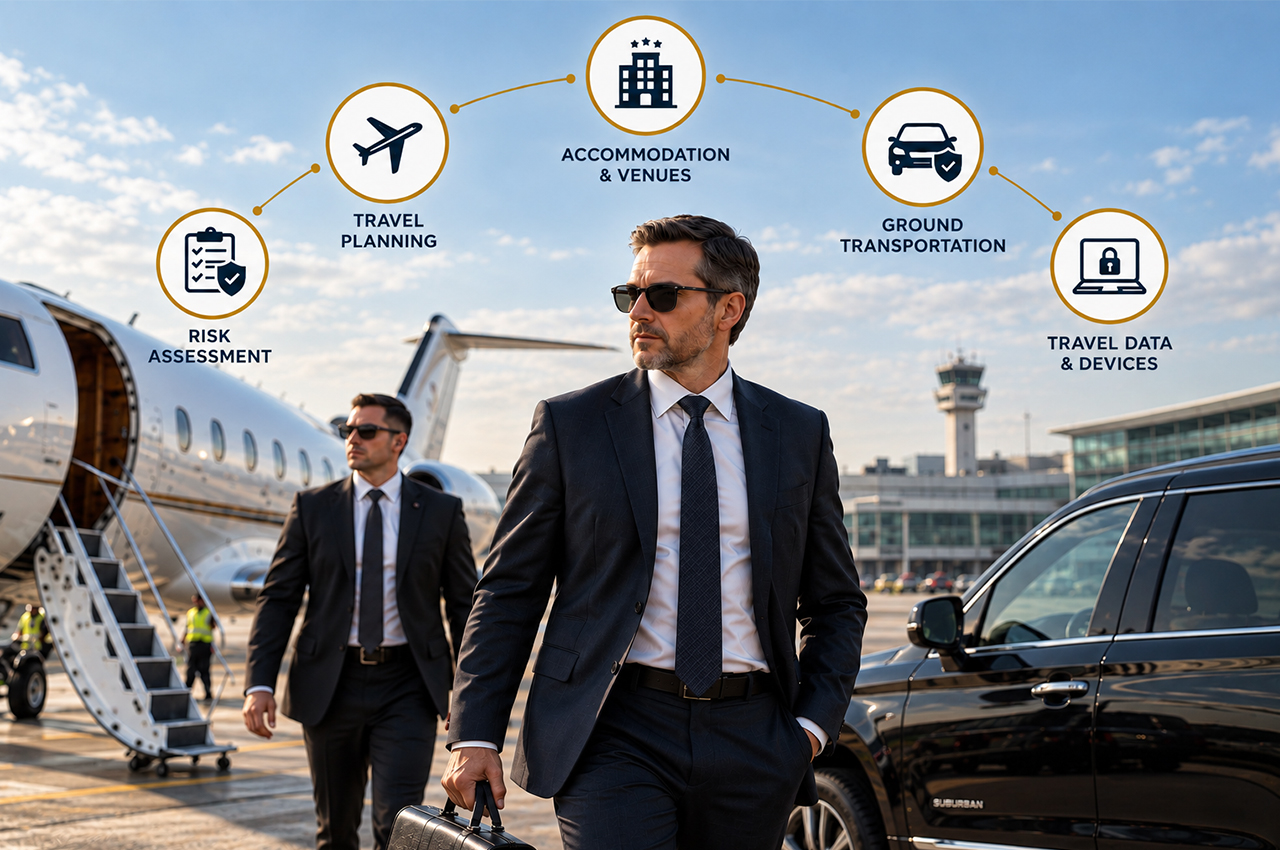
A complete approach addresses five areas:
- Destination and route risk: what is happening where the executive is going, and how they will move through it
- Accommodation and venues: the security of hotels, meeting locations, and event spaces
- Ground transportation: who drives, in what vehicle, and along which routes
- Travel data and devices: who knows the plan, and how information and equipment are protected
- Emergency and contingency planning: what happens if something goes wrong
The sections below take each in turn, following the order of a typical trip.
Before the Trip: Risk Assessment and Advance Planning
Most of the protection an executive receives on a trip is decided before they leave. Advance work is where risks are identified while there is still time to change the plan.
A sound pre-trip process starts with intelligence about the destination: current local events, recent incidents, and historical patterns. A destination that was routine six months ago may not be today, so information should be current rather than based on a general reputation.
Next comes route analysis. This means identifying primary and alternate routes, noting choke points and congestion areas, and thinking about timing so that movements don’t fall into a predictable pattern. It also includes site advances: assessing hotels, offices, and venues ahead of arrival, planning entry and exit points, and identifying safe areas and controlled paths of movement.
Practical items matter too. Where is the nearest capable medical facility? Who are the local contacts? What is the communication plan if phones or networks fail?
The goal is fewer surprises during the trip. Delta’s advance and route planning work follows this structure, using intelligence and operational context rather than fixed templates, so that the plan fits the person, the place, and the timing.
Protecting Travel Information
An itinerary is one of the most sensitive documents a company produces, yet it is often handled casually. It may be emailed to a dozen people, stored in a shared calendar, forwarded to a hotel, and mentioned in a vendor’s confirmation.
Several points of exposure come up repeatedly:
Assistants, calendars, and booking accounts. These hold dates, locations, and preferences in one place. If one is compromised, or simply set with broad access, the whole schedule can be exposed.
Vendors and partners. Travel agencies, hotels, drivers, and event organizers all receive details. Each is a possible leak, whether through carelessness or a breach on their side. Some events publish attendee lists or agendas that name senior speakers.
Social media. A photo tagged at an airport or a post about an upcoming conference can reveal a location, and sometimes a pattern. This applies to the executive, their family, and colleagues.
The principle is simple: share only what each person needs, when they need it, through channels you control. A driver needs pickup details, not the whole itinerary. A venue needs arrival time, not the hotel name.
This is also where digital and physical security meet. Information exposed online can inform physical targeting, which is why companies increasingly look at cyber-physical risk as one problem rather than two, reviewing how digital exposure affects the safety of the people they are trying to protect.
Devices and Connectivity on the Road
Executives carry sensitive information everywhere, and devices are easy to lose, borrow, or compromise. Travel adds risks that don’t exist at the office.
Public Wi-Fi in hotels, airports, and cafés can be unreliable or monitored. Shared charging ports and unfamiliar equipment introduce further uncertainty. And phones, laptops, and tablets are all more likely to be lost or taken during travel.
Reasonable precautions for a business audience include:
- Encrypting devices and using strong authentication
- Keeping software and security settings updated before departure
- Avoiding public networks for sensitive work, or using a trusted secure connection
- Considering clean or loaner devices for higher-risk destinations, so the executive isn’t carrying a full archive of company data
None of this requires deep technical knowledge. It requires a clear policy and someone responsible for checking it is followed.
During the Trip: Movement and Ground Transportation
Once the executive is on the ground, the plan is put to work. The most important variables are usually transportation, timing, and accommodation.
Ground transportation. Vetted drivers and vehicles are a baseline. It is worth confirming who is driving before arrival rather than accepting whoever is at the curb, and having a clear process for verifying identity at pickup.
Predictability. Varying departure times and routes reduces the chance of a pattern forming. Even small changes help.
Accommodation. Room selection, floor, and access arrangements should be considered in advance, along with how the executive arrives and checks in. Where possible, avoid announcing the executive’s presence.
Check-ins and coverage. Someone should always know where the executive is and how to reach them, with a defined process if a scheduled check-in is missed.
Emergency and Contingency Planning
Plans should account for things going wrong: a medical emergency, a security incident, a cancelled flight, or a sudden change in local conditions.
A workable contingency plan includes pre-identified diversion routes and safe locations, response arrangements for medical, security, and logistical incidents, and clear decision points. Just as important is knowing who decides, who is notified, and in what order. In an emergency, confusion about authority costs time.
Plans also need to be tested. A document that has never been reviewed or rehearsed often fails when it is needed. Even a short walkthrough with the travel team can expose gaps.
After the Trip: Debrief and Adjust
The end of a trip is an opportunity, not a finish line. A short debrief covering what went well, what didn’t, and what surprised the team gives you information to improve the next plan.
Useful questions include: Did the itinerary reach anyone it shouldn’t have? Were there delays or route problems? Did any vendor handle information poorly? Each answer feeds into better planning for the next trip.
Building a Company Travel Security Policy
Many companies handle travel security informally, relying on individual assistants or on the executive’s own habits. A written policy makes protection consistent and defensible. It should cover:
- Who is covered and at what level of risk or seniority
- Approval steps for travel to higher-risk destinations
- Information handling rules for itineraries, bookings, and communications
- Device and connectivity standards
- Roles and responsibilities, including who is accountable for advance work and emergency response
- Review and debrief requirements after each trip
A policy also supports duty of care, the responsibility companies have to reasonably protect people traveling on their behalf. Legal counsel and HR should be involved in shaping it so that it meets your organization’s obligations.
Final Thoughts
Executive travel security is not a single service or product. It is a discipline that combines careful advance planning, disciplined control of information, and clear plans for when things change. The companies that do it well treat every trip as an operation with a beginning, a middle, and a review, rather than a logistics task handled at the last minute.
If you would like to discuss how this applies to your organization’s travel program, you can contact Delta Strategic Solutions.