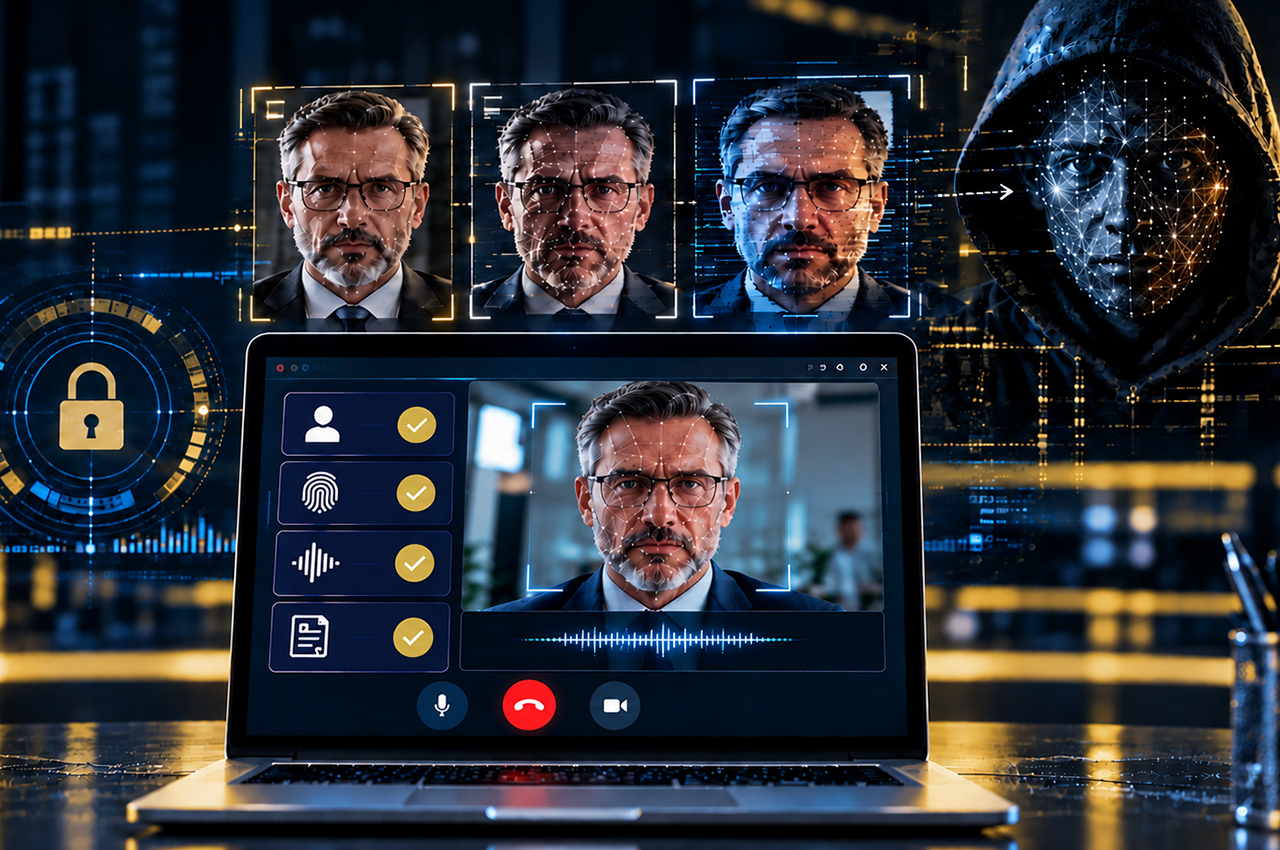
Deepfake fraud uses AI-generated voice, video, or images to impersonate a real person, often a senior executive, to trick employees into sending money, sharing information, or granting access. Effective deepfake fraud prevention relies less on spotting fakes and more on process: verification procedures, payment controls, limits on public exposure, staff training, and a clear response plan.
What Deepfake Fraud Actually Looks Like
A finance manager gets a call from the CEO. The voice is right: the tone, the pacing, even the verbal habits. The CEO says a confidential acquisition is closing and a payment must go out today. The request is urgent and private, and it feels legitimate.
The voice, however, was generated by software.
This is the core of deepfake fraud. Attackers use AI tools to clone a voice from a short audio sample or to produce video that appears to show a real person speaking. The technology has become cheaper and easier to use, so the barrier to entry has dropped. The FBI and other U.S. agencies have publicly warned about AI-generated voice and video in fraud and impersonation schemes.
Why Executives Are Prime Targets
Executives are attractive for a simple reason: their word carries authority. When a senior leader gives an instruction, employees are trained to act on it, and they are often reluctant to question it.
Executives are also easy to source material for. Earnings calls, conference talks, podcasts, media interviews, and company videos provide hours of clear audio and video. Every public appearance adds to the pool of samples an attacker can use. This is the same exposure problem discussed in our post on how social media can increase executive security risk, applied to voice and likeness.
Attackers don’t need a perfect fake. They need one that is good enough for a short call or message, delivered at a moment of pressure.
Common Deepfake Attack Scenarios
Payment and wire fraud. A cloned voice or video call pushes an employee to authorize a transfer, often framed as urgent and confidential. This is commonly called deepfake CEO fraud.
Credential and access requests. An “executive” or “IT administrator” asks for a password reset, a multi-factor authentication code, or access to a sensitive system.
Impersonation of vendors and partners. A fabricated voice or video of a known contact requests changed banking details or shares a malicious link.
Reputational manipulation. A fabricated clip of an executive saying something inflammatory can circulate online, creating confusion for customers, investors, and employees before it is debunked.
Physical access attempts. Impersonation can extend beyond the screen. A convincing call to a front desk, assistant, or building security team can be used to gain entry or learn a schedule. This is where digital deception becomes a physical security problem, and it is a core part of what social engineering and impersonation risk assessments are designed to evaluate.
Why Detection Alone Isn’t Enough
Many organizations first ask whether they can buy software that detects deepfakes. Detection tools exist and can help, but relying on them alone is risky for three reasons.
First, generation and detection improve in a continuous race, so a tool that works today may miss tomorrow’s fakes. Second, many attacks happen over channels where detection isn’t practical, such as a live phone call or a message on a personal device. Third, people are often unable to reliably tell a good fake from a real recording, especially under time pressure.
This is why strong deepfake fraud prevention focuses on making the attack fail even if the fake is convincing. That means building processes that don’t depend on anyone recognizing a fake voice.
Practical Deepfake Fraud Prevention Steps
1. Establish Out-of-Band Verification
Any request involving money, credentials, or sensitive data should be confirmed through a separate, pre-agreed channel. If the request arrives by phone, verify by calling back on a known number from your internal directory, not the number that just called. Never verify using contact details supplied in the suspicious message itself.
2. Use Verification Phrases for High-Risk Requests
Some organizations set up code words or challenge questions for executives and their close teams. These should be known only to the people involved, changed periodically, and never shared over email or text. This is a simple, low-cost control that AI cannot easily guess.
3. Tighten Payment and Approval Controls
Require dual approval for wire transfers above a set threshold, and don’t allow a single voice or message to override it. Build in a mandatory waiting period for changes to vendor banking details. A policy that says “no exceptions, even for the CEO” protects employees from having to argue with someone who sounds like their boss.
4. Reduce Unnecessary Public Exposure
You can’t remove executives from public view, but you can be deliberate. Review how much high-quality audio and video is available, consider who has access to internal recordings, and limit the sharing of internal town halls and calls. Also check what personal information, such as family details and travel plans, is publicly discoverable, since attackers use it to make impersonation believable.
5. Train the People Attackers Actually Target
Executive assistants, finance staff, help desk teams, and front-desk personnel are the usual entry points. Training should include realistic examples and, more importantly, explicit permission to pause and verify. Employees should know that questioning an urgent request from a senior leader is the correct behavior and will not be penalized.
6. Prepare a Response Plan Before It’s Needed
Decide in advance who is notified if a deepfake incident is suspected, how to preserve evidence such as call logs, recordings, and messages, and how to communicate with employees, partners, and possibly the public. Legal, communications, security, and IT should all have defined roles. If funds have been sent, speed matters, so contacting the bank and law enforcement quickly is critical.
7. Connect Digital and Physical Security
Impersonation doesn’t stay in one domain. A fake voice that obtains a schedule can lead to a physical approach, and a physical lapse can expose credentials and devices. Coordinating your cybersecurity, physical security, and executive protection functions helps ensure that a digital warning sign reaches the people who can act on it.
What Good Governance Looks Like
Deepfake risk should not sit solely with IT. Finance, legal, communications, HR, and physical security all have a stake. A workable approach includes:
- A named owner for impersonation and deepfake risk
- Written verification and approval procedures
- Regular tabletop exercises that simulate an impersonation attempt
- A periodic review of executive digital exposure
- Clear escalation paths between cybersecurity and physical security teams
The goal isn’t perfection. It’s making your organization a harder, slower, and less rewarding target than the next one.
Frequently Asked Questions
What is deepfake fraud?
Deepfake fraud is the use of AI-generated audio, video, or images to impersonate a real person for financial gain or manipulation. Common examples include cloned executive voices used to request wire transfers or credentials.
How does voice cloning work in scams?
Attackers use AI software trained on recordings of a person’s voice, often taken from public interviews, calls, or videos. The software can then generate speech that mimics that person saying anything the attacker types.
How can companies prevent deepfake fraud?
The most reliable approach combines out-of-band verification, dual approval for payments, verification phrases for high-risk requests, staff training, and limits on unnecessary public exposure. Technology can support these measures but shouldn’t be the only line of defense.
Can people tell if a voice or video is fake?
Not reliably. Quality varies, but many people struggle to distinguish good fakes from real recordings, especially during a rushed call. That’s why process-based controls matter more than trying to “spot” a fake.
What should we do if we suspect a deepfake attack?
Stop the requested action, verify through a separate trusted channel, preserve all evidence, and notify your security, legal, and finance teams. If money has moved, contact your bank and law enforcement immediately.
Are deepfakes only a risk for large companies?
No. Smaller organizations, family offices, and private individuals can be targeted too, sometimes because they have fewer controls in place.
Final Thoughts
Deepfake technology will keep improving, and no organization can rely on human ears and eyes to catch every fake. Sound deepfake fraud prevention starts with accepting that a convincing voice or face is no longer proof of identity. Organizations that build verification into how they operate, and connect digital and physical security, are far better positioned to stop an attack before it succeeds.
To learn how Delta approaches impersonation and exposure risk, see our Cyber-Physical Risk Integration services or contact our team.