
What does it really mean when someone says, “We’ve been hacked”?
The first thing that comes to our mind when our device is hacked is that, why? How? I didn’t click anything what will happen to our bank details, compromised passwords, private messages, and important documents. We panic a lot because how can someone not, our phones and laptops hold personal information, business records, travel details, contact lists, and access to systems we depend on every day.
We tend to feel that it’s all our fault, but a cyber threat is not always caused by one careless click and here’s what the data shows:
The Identity Theft Resource Center tracked over 471 million victim notices across 1,803 separate data compromises in the U.S. during the first half of 2026.
2026 Tracking Overview
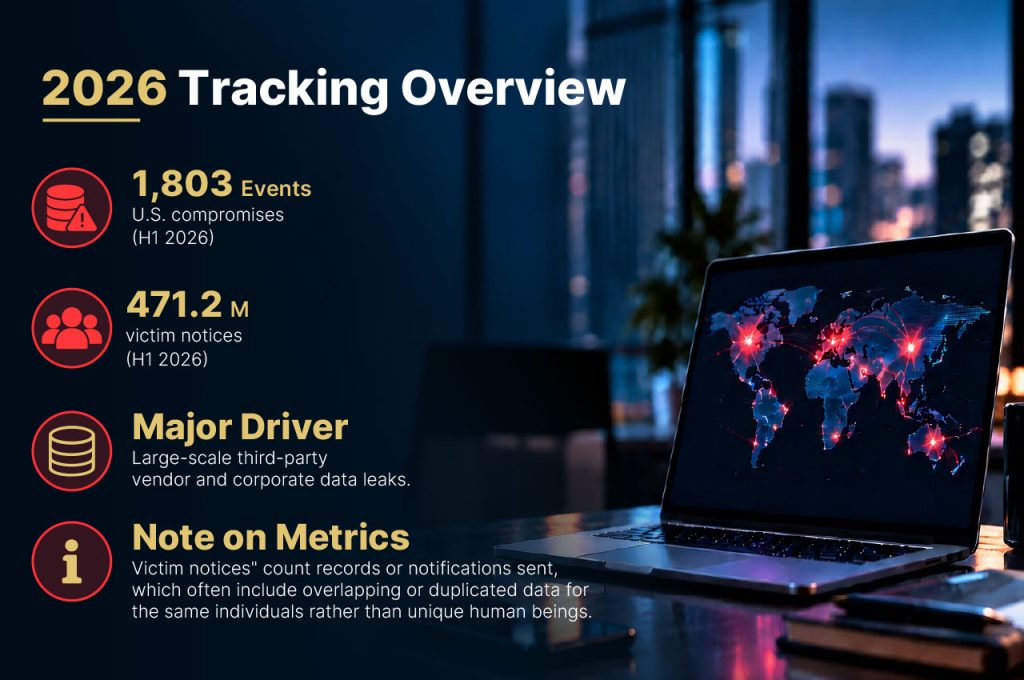
The scale of these incidents shows that cyber exposure is not simply a personal failure. Organizations can be affected even when their employees follow reasonable security practices.
What is a threat assessment?
Most of the people don’t know that they can get a professional’s help in assessing a threat and needs to understand how important it is for an individual, lets understand what threat assessment actually is, a threat assessment is a structured, evidence-based process used to identify potential threats, understand how those threats could affect an organization, determine how credible and urgent they are, and decide what action should be taken. Which is crucially important for every organization and individual as threats are everywhere and taking precautions will help for future security.
Hackers are one step ahead of us, so we must identify and prevent ourselves. Not everyone is able to identify threats easily, and you need professional guidance for them. That’s what Delta’s Cyber‑Physical Risk Integration brings for you.
In cybersecurity, this may include examining:
- The type of information exposed.
- The systems, accounts, or individuals at risk.
- The likely intent and capability of a threat actor.
- The credibility and urgency of the warning signs.
- The possible impact on business operations.
- The controls required to reduce or manage the risk.
Also, theirs another important scenario that is very important to know which is that it doesn’t just stop on these cyber threats the hacker can also access executive’s travel schedule details, can impersonate a senior employee, or can use leaked information to manipulate staff which can lead to physical threat in physical environment.
This is the connection between cybersecurity and physical security.
When cyber risk becomes physical risk
Cyber risks are increased in such a way that now it’s affecting the physical environment of an executive, we think that being “hacked” just means that our device is hacked and nothing else could happen but no its something more to that, the person who hacked your device would have a reason as digital information can also reveal patterns, relationships, locations, routines, and operational details, which route you travel, track your moments as to when plan the attack by keeping tabs on your moments, and it’s very crutial to know that every cyber threat as a motive or a purpose and need to keep two factor authentication in real life too so to be safe and have a secure future.
Also Online or compromised information may reveal:
- Where an executive is expected to attend an event.
- Which employees have authority to approve access.
- How a visitor or contractor enters a facility.
- Which suppliers support critical operations.
- When a senior leader is travelling.
- Which personal or corporate accounts are connected to an individual.
Individually these may appear harmless but , when combined, they can help someone plan impersonation, unauthorized access, harassment, theft, surveillance, or physical targeting and in no time someone would know where you’re boarding too or are in a meeting or anywhere in the world.
This does not mean that every online mention represents an immediate threat. It means that digital exposure should be assessed in context, alongside physical access, operational activity, executive visibility, and current security conditions.
What is Cyber-Physical Risk Integration?
Cyber-physical risk integration means connecting digital intelligence with physical-security decision-making, in simple words it means looking at both physical as well as cyber threats and the physical damage they could cause in real world.
But an organization needs to understand that not every cyber risk is connected with physical emergency, instead it actualy helps organization to determine whether these digital indicators should influence protective planning, security monitoring, access controls, travel arrangements, or incident response.
For example, an organization may need to examine whether:
- A leaked executive itinerary affects travel or protection planning.
- A fake employee profile could be used to gain facility access.
- An unusual account login is connected to physical access activity.
- A social-engineering attempt could expose sensitive operational information.
- Insider-risk indicators appear across both digital and physical environments.
This is where a professional threat assessment proves its worth. And Delta Strategic Solutions clearly states it and assists organizations in linking digital exposure to physical-security concerns, enabling leadership to grasp what cyber indicators might signify in real-world terms.
In Delta’s cyber-physical risk integration and security services. (will keep the real link) you”l learn in breif as to how and what cyber-physical integration is and how we guide you through it.
Now let’s understand why it matters:
Why Threat Assessment Matters?
Before taking any action the organization should know the shift that has to happen which is the difference between reacting to every alert like it’s a five-alarm fire, to actually knowing which ones deserve that reaction. Because without a real process behind it, an organization ends up doing one of two things. Either it brushes off a warning that turns out to matter, or it burns hours and budget chasing something that was never a real threat to begin with. And then its not good for your business and you would be answerable for the things which you thought you knew but turns out totally different.
And to not repeat or make any future mistakes you would need a structured threat assessment that will guide you how and when to think practically with facts instead of going with your gut, and what’s worth escalating and what can simply be watched or handled through everyday security hygiene which is updating software, using strong passwords, backing up data, locking screens, that kind of thing. Nothing dramatic, just basic upkeep done consistently that will keep systems reasonably safe.
Let’s see what a proper assessment actually does for an organization:
- Finds the vulnerabilities before someone else does. It’s a lot cheaper to fix a gap than to clean up after it’s been exploited.
- Protects the information and systems that actually matter. Not everything needs the same level of protection, and a good assessment tells you what does.
- Tightens up access and authentication. Who can get into what, and how easily, says a lot about how exposed an organization really is.
- Builds real security awareness among employees. Most breaches don’t start with a genius hacker. They start with someone clicking the wrong thing because nobody told them what to look for.
- Helps prioritize where the security budget actually goes. Not every dollar needs to go toward the loudest alert.
- Improves how incidents get reported and handled. The faster something gets flagged internally, the faster it gets contained.
- Prepares the organization for the attacks that are actually likely, not just the ones that make headlines.
- Shrinks the damage if something does get through, because a plan already exists instead of being built in the middle of a crisis.
- And one of the most significant reasons this is important: social engineering. Here, an attacker doesn’t waste effort trying to get past your firewall. They simply pose as someone you trust: a vendor, a colleague, at times even your own CEO, and request the single thing they’re after. A password. A wire transfer. A door held open.
CISA, the federal agency that tracks this kind of thing, points to three things that actually move the needle here: training people to recognize the signs, verifying identity before acting on a request, and using multifactor authentication so a stolen password isn’t enough on its own. A threat assessment is how you find out where your organization is actually exposed to this before someone else finds it first.
So the real question a threat assessment is built to answer is simple: is this just a suspicious event, or is it a sign of something bigger? That’s the line between overreacting and staying ahead.
How Delta Helps Assess Cyber Risk
This is exactly the gap Delta Strategic Solutions’ Cyber-Physical Risk Integration service is built to close.
Delta looks at how a digital threat could ripple outward: into your systems, your information, your executives, your employees, and the way your business actually runs day to day. That means reviewing where you’re digitally exposed, spotting the vulnerabilities, weighing how credible and urgent each threat indicator really is, and recommending controls that actually fit your risk, not a generic checklist.
The point was never to just say “yes, a threat exists.” The point is to give leadership answers to the questions that actually matter:
How serious is this, really?
Who or what is actually at risk here?
How likely is this to succeed?
What happens if it does?
What can we do about it right now?
And sometimes, the answer to those questions crosses over into the physical world. A leaked travel schedule. Access procedures that got exposed somewhere they shouldn’t have. Someone impersonating a senior employee to get past a front desk. These aren’t hypothetical, and they’re exactly why Delta’s approach treats cyber and physical risk as connected, not separate boxes to check.
You can learn more about Delta’s cyber-physical risk integration and security services (will keep the real link).
Short conclusion
At the end of the day, a threat assessment isn’t about assuming every alert is an attack in progress. It’s about actually looking at what’s in front of you, figuring out how likely it is to matter, and deciding what to do about it before it becomes a bigger problem than it needed to be.
And sometimes, a digital warning is telling you something about your physical security too. With the right guidance, organizations can catch that connection early, before it turns into something that affects their people, not just their data.