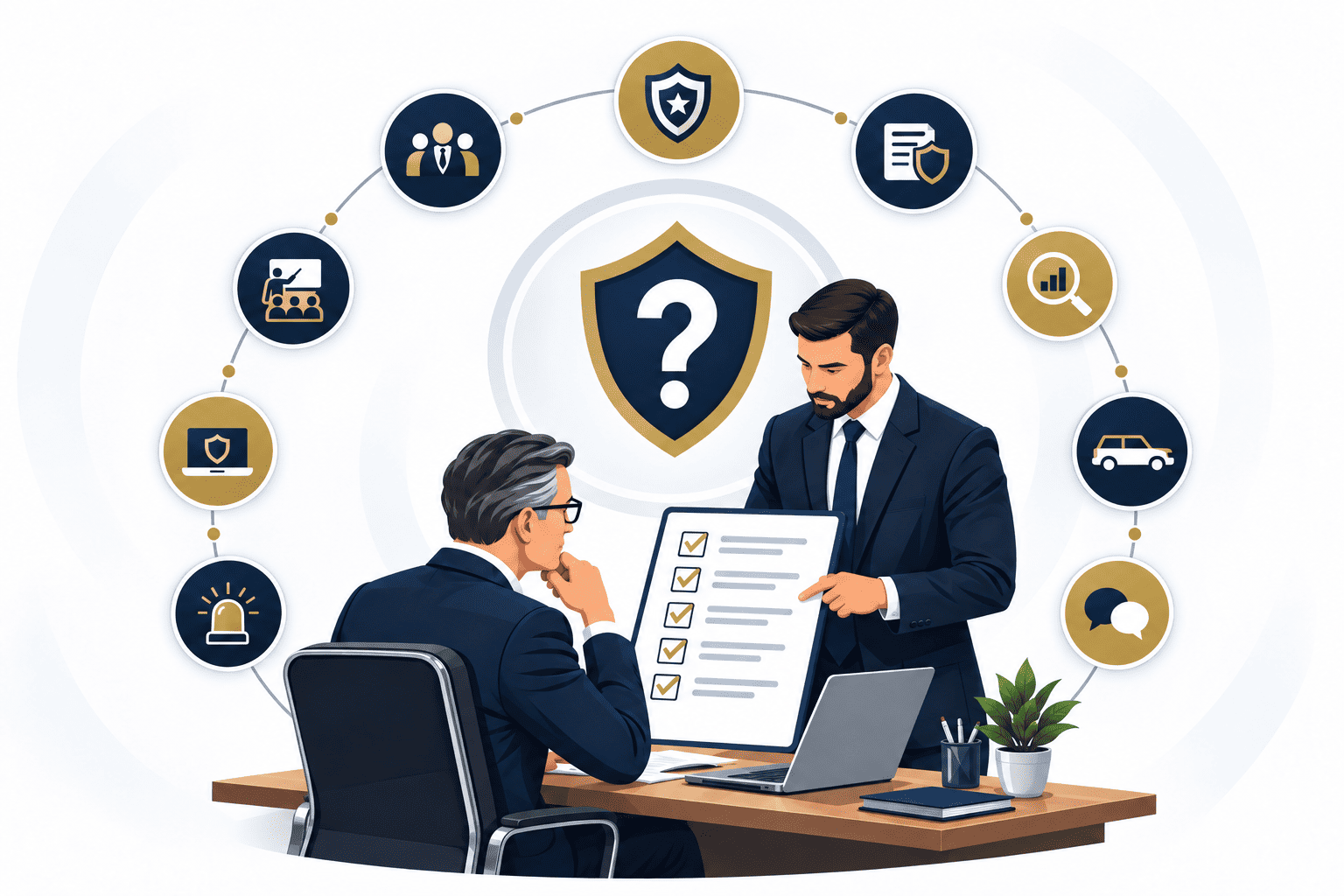
“Converged” gets used loosely in security sales. For some firms it means a protective detail with a cybersecurity contact on speed dial. For others it means one report with a physical section and a digital section stapled together. Neither gives a principal much more than they had before.
A converged executive protection program treats a person’s physical safety and digital exposure as one risk, owned by one team and managed under one plan.
In our last piece we looked at where physical-only and cyber-only coverage leave gaps. This one walks through what a program built to close those gaps actually includes, in roughly the order the work happens.
Step 1: Define who and what is being protected
The first step sets the scope, and the principal is rarely the only person in it. Spouses, children, executive assistants and household staff all hold pieces of the schedule, and most of them are far easier to reach than the executive.
Scoping also names the business events that change the risk. An IPO, a round of layoffs, pending litigation, a relocation or a public dispute with shareholders can each raise exposure overnight. Those dates shape everything that follows.
Step 2: Run one assessment across physical and digital exposure
This is where a converged program first looks different. Instead of a physical survey in the spring and a cyber review six months later, a single threat and risk assessment covers both at the same time.
On the physical side, that means the residence, the office, regular routes and the venues the principal visits often. On the digital side, it means data broker listings, breached credentials, family social media accounts, personal devices and the home network. The value comes from reading them together. A home address on a people-search site carries more weight when the house sits on a cul-de-sac with one road in and out.
Detailed vulnerability assessments and an executive digital vulnerability assessment feed straight into this step.
Step 3: Build a single risk picture and protection plan
The findings become one prioritized threat model instead of two separate reports. From it comes the plan: the level of coverage, who is on the detail and when, what gets monitored, and which exposures get fixed first.
A good plan also says what the program won’t do. Principals care about privacy and routine, and protection that ignores both tends to get quietly worked around.
Step 4: Reduce exposure before adding coverage
Reducing exposure usually comes before adding people and vehicles, because it’s where the cheaper wins are. On the digital side, that means removing personal data from broker sites, tightening account security and keeping family devices separate from anything the office manages. On the physical side, it means residential and estate security improvements and access control that fits how the household actually lives.
Every exposure closed here is one the detail doesn’t have to watch later.
Step 5: Monitor both domains with the same analysts
Protective intelligence in a converged program watches for impersonation accounts, leaked itineraries and fresh breach data alongside the familiar physical signs, such as repeat visitors, fixated letters or unusual interest in an upcoming event. The same analysts review both streams, so a pattern that starts online and ends at the front gate is recognized as one pattern. Security monitoring at the residence and office covers the ground those analysts can’t see from a screen.
Step 6: Plan travel and movement with digital discipline built in
Advance and route planning and secure transportation are standard in any executive protection program. What changes here is that the itinerary itself is handled as sensitive information. It goes to a short list of people, travel devices are kept clean, and nobody in the party posts from the hotel until the principal has checked out.
Step 7: Agree on how findings trigger action
This step looks small on paper, yet it decides whether the program works. The team writes down what happens when a digital finding has physical consequences, and the other way around. If an assistant’s inbox is compromised and next week’s travel was sitting in it, the route changes. If the same unfamiliar car appears outside the office twice, someone checks what has been posted publicly about that location.
Delta’s crisis and incident response work runs on playbooks like this, so no one is inventing the process in the middle of an incident. One of the engagements in our case studies involved a chairman targeted by a coordinated spear-phishing campaign across several countries, which is exactly the kind of situation where the digital response and the physical plan need to move together. We’ve written before about how cyber attacks can turn into physical threats.
Step 8: Train the household and review the plan
The people around the principal need short, practical training on how to spot a pretext call, what not to post and who to call when something feels off. Executive and corporate training covers this for assistants, family members and staff.
The plan is reviewed on a set schedule, and again whenever one of the events named in Step 1 comes up.
Questions to ask a provider claiming convergence
Before signing with anyone who describes their service as converged executive protection, ask:
- Is the physical and digital assessment done by one team, at the same time?
- Who decides when a digital finding changes the protection plan, and how fast?
- Will they work alongside your in-house security, IT and legal teams?
- How do they handle confidentiality with family members and household staff?
Vague answers to any of these usually mean two services sold under one name.
How Delta builds converged protection
Delta Strategic Solutions has provided intelligence-driven protection since 2002, working with executives, families and organizations across the United States, with a strong focus on New York and Florida. Our executive protection services and cyber-physical risk integration specialists work from the same assessment and the same plan, with senior leadership involved from the first conversation.
FAQ